https://pubs.acs.org/doi/10.1021/acs.molpharmaceut.5c00902
https://sj.jst.go.jp/news/202601/n0128-03k.html
A research group from Kumamoto University has established groundbreaking fundamental technology toward realizing oral insulin.
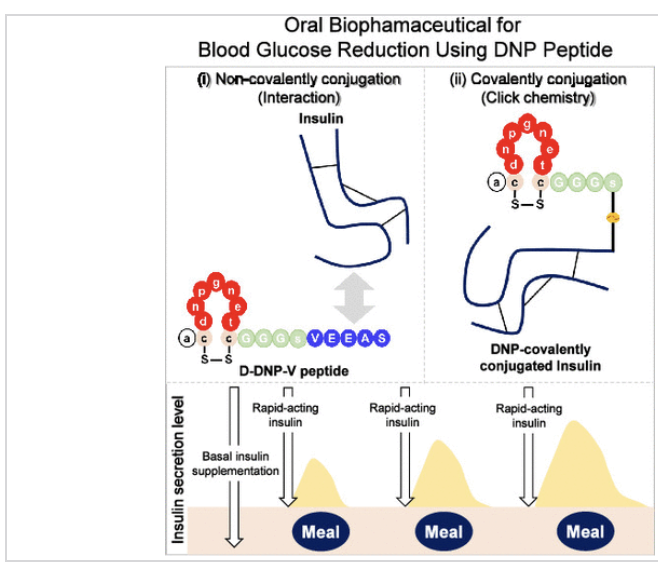
Oral administration of insulin is hindered by enzymatic degradation and poor intestinal permeability. The team engineered DNP-V, a modular carrier peptide, fused to an insulin-interacting peptide, and demonstrated that the coadministration of DNP-V with zinc-stabilized insulin hexamers in diabetic mice enables a rapid, robust, and sustained reduction in blood glucose levels to near-normal levels. This effect was reproducible across multiple diabetic models, achieving significant suppression of the initial postprandial glucose surge with once-daily oral dosing. This platform can be easily applied to long-acting insulin analogs, allowing for oral delivery without the need for complex preparation changes.
Covalent conjugation of DNP peptides to insulin via click chemistry yielded stable insulin conjugates that significantly enhanced intestinal absorption and produced comparable oral glucose-lowering effects.
These results establish fundamental technology for oral insulin drug development using two approaches: mixing (interaction) and conjugation (covalent bonding).