
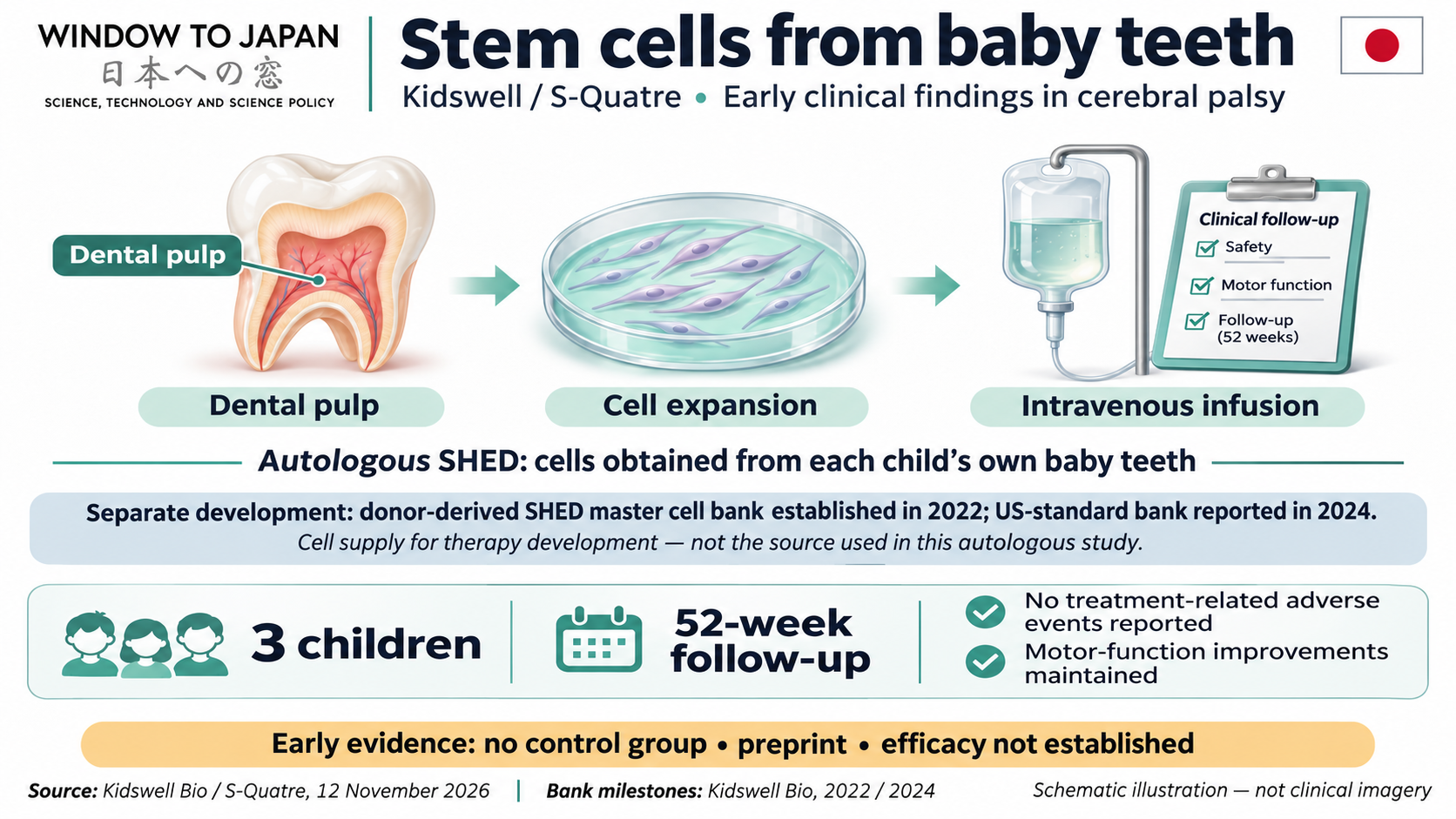
In brief: A Japanese study has reported encouraging one-year findings following treatment of three children with stem cells obtained from their own baby teeth. No treatment-related adverse events were reported, and improvements in motor function persisted throughout follow-up. However, the small, uncontrolled study cannot establish efficacy.
On November 12, 2026, Kidswell Bio and its subsidiary S-Quatre announced the final analysis of a Nagoya University-led clinical study using stem cells from human exfoliated deciduous teeth, known as SHED.
Three children aged six to eleven with cerebral palsy received a single intravenous infusion of their own cultured cells. After 52 weeks, their Gross Motor Function Measure (GMFM-66) scores had increased by an average of 4.5 points from baseline. Exploratory MRI findings in two children also suggested changes in white-matter fibre pathways, but these require cautious interpretation.
Source: Kidswell Bio/S-Quatre announcement, November 12, 2026 · Study preprint
From tooth donation to a cell supply platform
Alongside its clinical programme, Kidswell has established an organised system for collecting donated baby teeth and manufacturing SHED master cell banks. Working with participating hospitals and Nikon CeLL innovation, the company completed a GMP-compliant bank in August 2022. In March 2024, it reported a bank manufactured to meet US FDA standards, including donor eligibility requirements.
This provides starting material for therapy development, not an approved treatment. It is separate from the present study, which used each child’s own cells.
Sources: Master cell bank announcement, August 2022 · US-standard bank announcement, March 2024
An early clinical signal, not an established therapy
For W2J readers, this is a clinical follow-up to our earlier coverage of dental pulp stem-cell banking. It illustrates a regenerative-medicine approach distinct from iPS technology: expanding cells already present in dental pulp rather than reprogramming mature cells into pluripotent stem cells.
The final study results are currently available as a preprint awaiting peer review. With only three participants and no control group, the observed improvements cannot reliably be attributed to the treatment. Larger controlled studies are needed. Moreover, these autologous findings do not demonstrate the effectiveness of an allogeneic, donor-bank product.
Earlier W2J coverage: Gene Techno Science’s development programme for dental pulp-derived stem cells, March 2019