
In brief
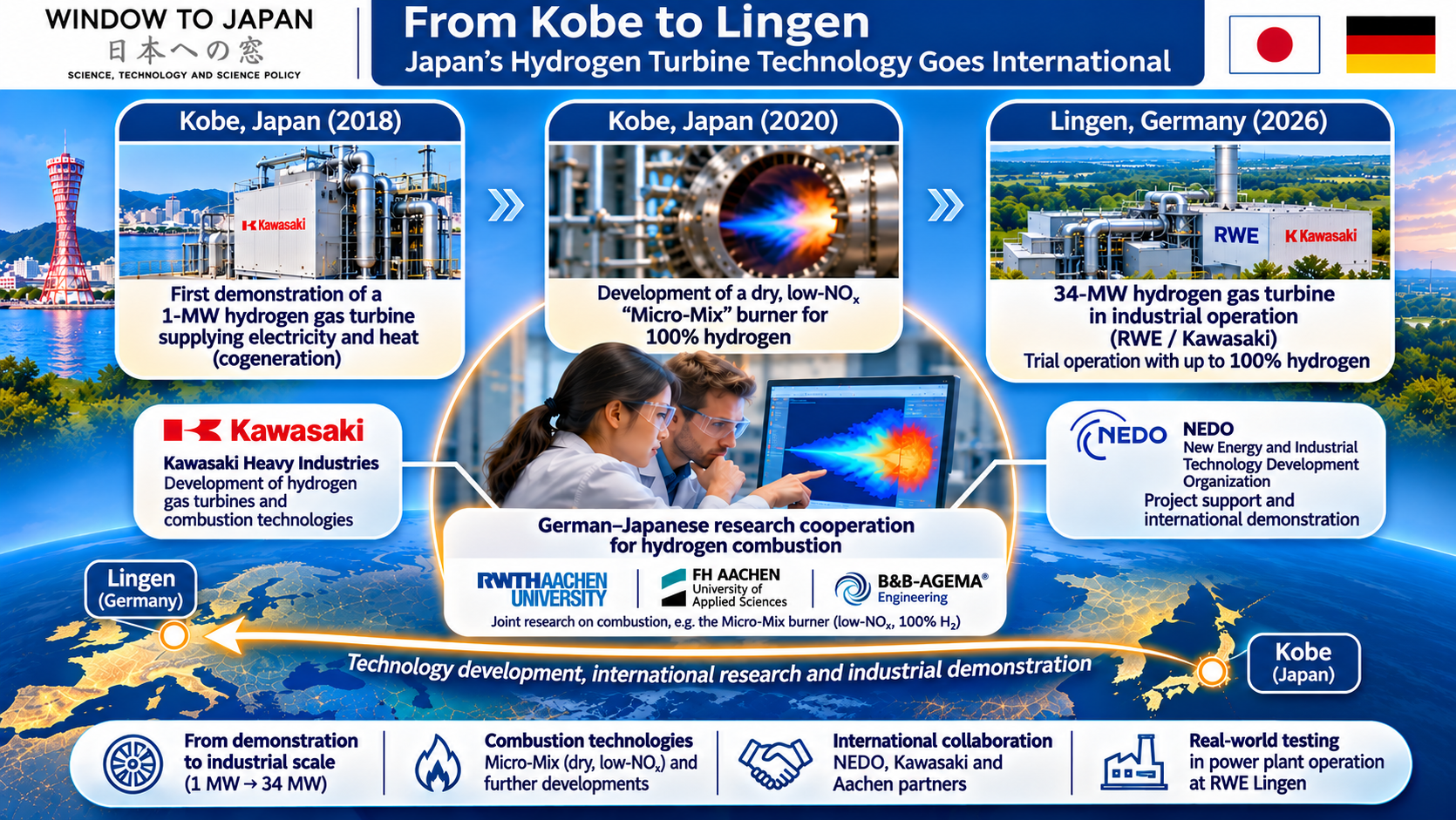
Japan’s hydrogen gas turbine technology is moving from domestic demonstration to international industrial testing. In 2018, Kawasaki Heavy Industries demonstrated a 1 MW-class gas turbine cogeneration system running on 100% hydrogen in Kobe. In 2020, work on a dry, low-NOₓ Micro-Mix combustor marked a further research milestone. On 6 November 2026, Kawasaki and Germany’s RWE began trials with a much larger 34 MW hydrogen-capable gas turbine at Lingen, supported by Japan’s NEDO.
The story is not a straightforward scale-up of one burner: the Kobe Micro-Mix research and the Lingen turbine employ different combustion concepts. Germany also contributes research expertise through RWTH Aachen, FH Aachen and B&B-AGEMA. Lingen is a major international demonstration, but sustained commercial operation on pure hydrogen has yet to be proven.
Further reading – milestones, combustion technology and international partnerships
1. 2018: Hydrogen cogeneration in Kobe
Kawasaki demonstrated a 1 MW-class gas turbine cogeneration system capable of using 100% hydrogen in Kobe. The project illustrated that hydrogen could fuel a turbine while providing both electricity and useful heat. It established an important early practical basis for Japan’s hydrogen turbine development.
Source: Kawasaki – hydrogen turbine development in Kobe.
2. 2020: A different combustion pathway
Kawasaki’s dry, low-NOₓ Micro-Mix research seeks to manage hydrogen’s high flame speed and nitrogen oxide formation without relying on water or steam injection. This is a distinct technical approach from the wet diffusion combustion concept used for the Lingen demonstration. The two developments belong to Kawasaki’s broader hydrogen combustion programme but should not be presented as identical burner technology.
Source: Kawasaki – technology background.
3. 2021–2026: From Japanese development to a European power station
RWE and Kawasaki developed plans for a hydrogen-capable turbine demonstration in Germany. The L30A-class turbine was manufactured in Japan, while Kawasaki’s European organisation and RWE contributed to integration at the Emsland site. On 6 November 2026, trial operations started with a 34 MW installation designed to use natural gas, hydrogen or variable blends up to 100% hydrogen.
The key step is not simply the larger nameplate capacity. It is the attempt to validate hydrogen combustion and flexible operation in a real European power-station environment. Long-term reliability, emissions and performance remain subjects of the trials.
Sources: RWE, 6 November 2026 · NEDO, 9 November 2026.
4. International research partners – not only RWE
RWE is the industrial demonstration partner at Lingen, but international cooperation is broader. Kawasaki’s hydrogen combustion research has involved German expertise, including RWTH Aachen, FH Aachen and engineering company B&B-AGEMA, particularly in Micro-Mix burner development and combustion testing. NOW GmbH has served as an institutional counterpart in the NEDO–Germany cooperation framework; it should not be described as a turbine manufacturer.
Public project information identifies RWE as the operator of this particular international turbine demonstration. That does not establish that Kawasaki has no other overseas research or commercial relationships.
5. Japanese hydrogen turbine development beyond Kawasaki
Mitsubishi Heavy Industries is pursuing its own hydrogen combustion technologies at Takasago Hydrogen Park, including tests on smaller industrial gas turbines and hydrogen co-firing in larger machines. These are separate technology programmes, not parts of Kawasaki’s NEDO–RWE project. They demonstrate that Japan’s hydrogen turbine research encompasses multiple manufacturers and combustion strategies.
Source: Mitsubishi Heavy Industries – technical review.
6. What the Lingen project means for Japan
NEDO’s support for an overseas demonstration helps Japanese developers test technology under foreign regulatory, infrastructure and operating conditions. For Kawasaki, Lingen offers experience in a larger turbine class and a European industrial reference. For RWE, the installation is one element of a broader programme of electrolysis, hydrogen infrastructure, flexible power and energy storage.
Milestones at a glance
| Year | Milestone | Significance |
|---|---|---|
| 2018 | Kobe: 1 MW-class turbine on 100% hydrogen | Domestic cogeneration demonstration |
| 2020 | Kobe: dry Micro-Mix combustion development | Alternative low-NOₓ burner concept |
| 2021–2026 | Japan–Germany development and integration | International demonstration preparation |
| 2026 | Lingen: 34 MW trial operations begin | Industrial-scale evaluation; durability and 100% H₂ performance still to be established |
View from Europe
The companion Window-to-Europe article, “RWE’s Lingen Energy Hub: Integrating Hydrogen, Power Generation and Energy Storage”, examines the broader site, including electrolysis, hydrogen supply and flexible electricity generation.https://window-to-europe.eu/2026/11/12/rwes-lingen-energy-hub-integrating-hydrogen-power-generation-and-energy-storage/
Sources
NEDO, 9 November 2026 · Kawasaki – Kobe background · RWE, 6 November 2026 · MHI – technical review.