
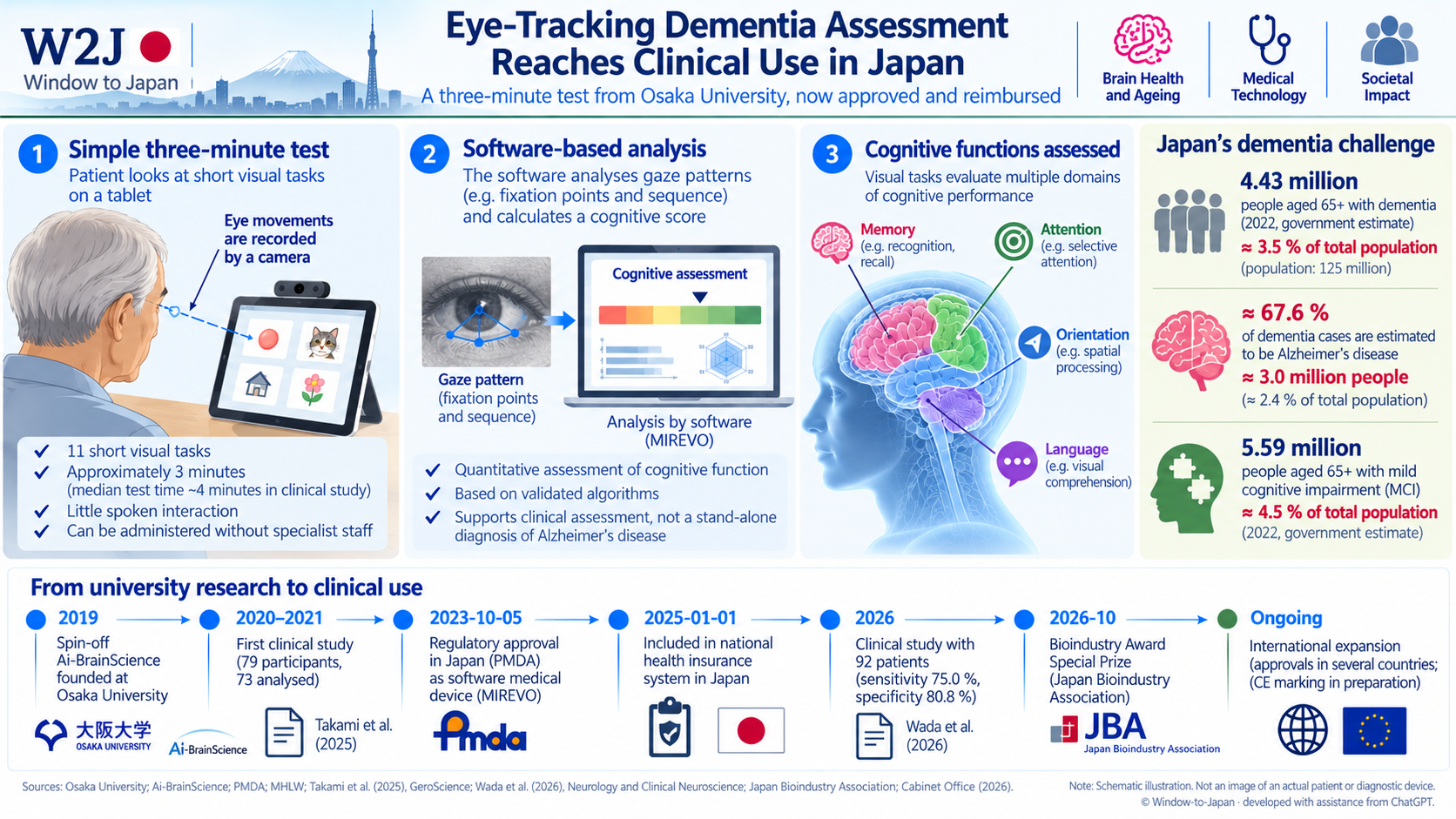
Osaka University spin-off develops a rapid cognitive assessment system — approved and reimbursed in Japan, with international expansion underway.
In brief
Japan has introduced MIREVO, an eye-tracking-based software medical device originating from research at Osaka University. Patients complete short visual tasks while their eye movements are recorded and analyzed to assess cognitive function. MIREVO received Japanese regulatory approval in October 2023 and became eligible for national health insurance reimbursement in January 2025. In October 2026, the Japan Bioindustry Association recognized the achievement with a Bioindustry Award Special Prize.
Source: Japan Bioindustry Association – Bioindustry Awards 2026.
Japan’s dementia challenge
According to Japanese government estimates, approximately 4.43 million people aged 65 and older were living with dementia in 2022, equivalent to about 3.5% of Japan’s total population. Another 5.59 million older people were estimated to have mild cognitive impairment (MCI), representing approximately 4.5% of the total population.
Earlier epidemiological estimates suggest that Alzheimer’s disease accounts for roughly two-thirds of dementia cases. Applying this proportion to the more recent dementia estimate would correspond to approximately 3 million people, or 2.4% of Japan’s total population. This is an approximation rather than a separate current prevalence estimate.
Sources: Japanese government – Dementia policy and prevalence; Statistics Bureau of Japan – Population estimates.
Measuring cognitive function through eye movements
MIREVO uses a series of short visual tasks presented on a tablet. An eye-tracking camera records the patient’s gaze patterns, including fixation points and sequences. Software analyzes these patterns to generate a quantitative cognitive assessment score.
The procedure requires little spoken interaction and offers a relatively rapid alternative to conventional questionnaire-based cognitive testing. Although the visual tasks take approximately three minutes, the median examination time reported in a clinical study was slightly longer than four minutes.
MIREVO supports the assessment of cognitive impairment but does not independently diagnose Alzheimer’s disease or determine its underlying pathology.
Source: Otsuka Pharmaceutical – MIREVO regulatory approval.
Clinical validation
The initial clinical study recruited 79 participants, with 73 completing the eye-tracking assessment and entering the principal analysis. The results showed a strong correlation with the Mini-Mental State Examination (MMSE), an established method of cognitive assessment.
A subsequent study involving 92 patients at a Japanese memory clinic reported a correlation with the MMSE of r = 0.603. For distinguishing dementia from non-dementia, the reported area under the ROC curve was 0.830, with 75.0% sensitivity and 80.8% specificity at the selected cutoff.
These findings demonstrate the potential of eye-tracking technology as a rapid clinical assessment tool. However, the relatively small study populations underline the need for further validation, particularly in early-stage cognitive impairment and across broader patient groups.
Sources: Takami et al., GeroScience (2025); Wada et al., Neurology and Clinical Neuroscience (2026).
From university research to clinical practice
Ai-BrainScience, a spin-off originating from Osaka University research, obtained Japanese marketing approval for MIREVO on October 5, 2023. The product is classified as software for neuropsychological assessment supporting dementia care.
Otsuka Pharmaceutical distributes MIREVO in Japan. National health insurance reimbursement began on January 1, 2025, marking an important step toward routine clinical use.
Sources: Ai-BrainScience – Japanese regulatory approval; Otsuka Pharmaceutical – Reimbursement and commercialization.
International expansion and next-generation technology
Ai-BrainScience is pursuing international commercialization. By September 2025, the company reported regulatory approvals in Indonesia, Malaysia, the Philippines and Australia, as well as a US registration. These regulatory statuses are not necessarily equivalent; US registration alone does not constitute FDA marketing clearance or approval.
In Europe, the company identifies CE marking as a development objective. However, a completed EU medical device certification or routine commercial availability in Europe could not be confirmed as of October 2026.
Meanwhile, a second-generation system is under development, aiming to apply artificial intelligence and machine learning to more detailed gaze trajectories and potentially provide additional information about cognitive impairment.
Sources: Ai-BrainScience – International regulatory developments; Ai-BrainScience – Product development.
Recognition by the Japan Bioindustry Association
In October 2026, the Japan Bioindustry Association presented its Bioindustry Award Special Prize to Shuko Takeda of Osaka University for the development and clinical implementation of eye-tracking-based cognitive assessment.
The achievement illustrates the successful translation of academic research into an approved medical device. Its significance lies in combining a relatively simple, rapid assessment procedure with regulatory approval, reimbursement and the prospect of wider international application.