
Summary
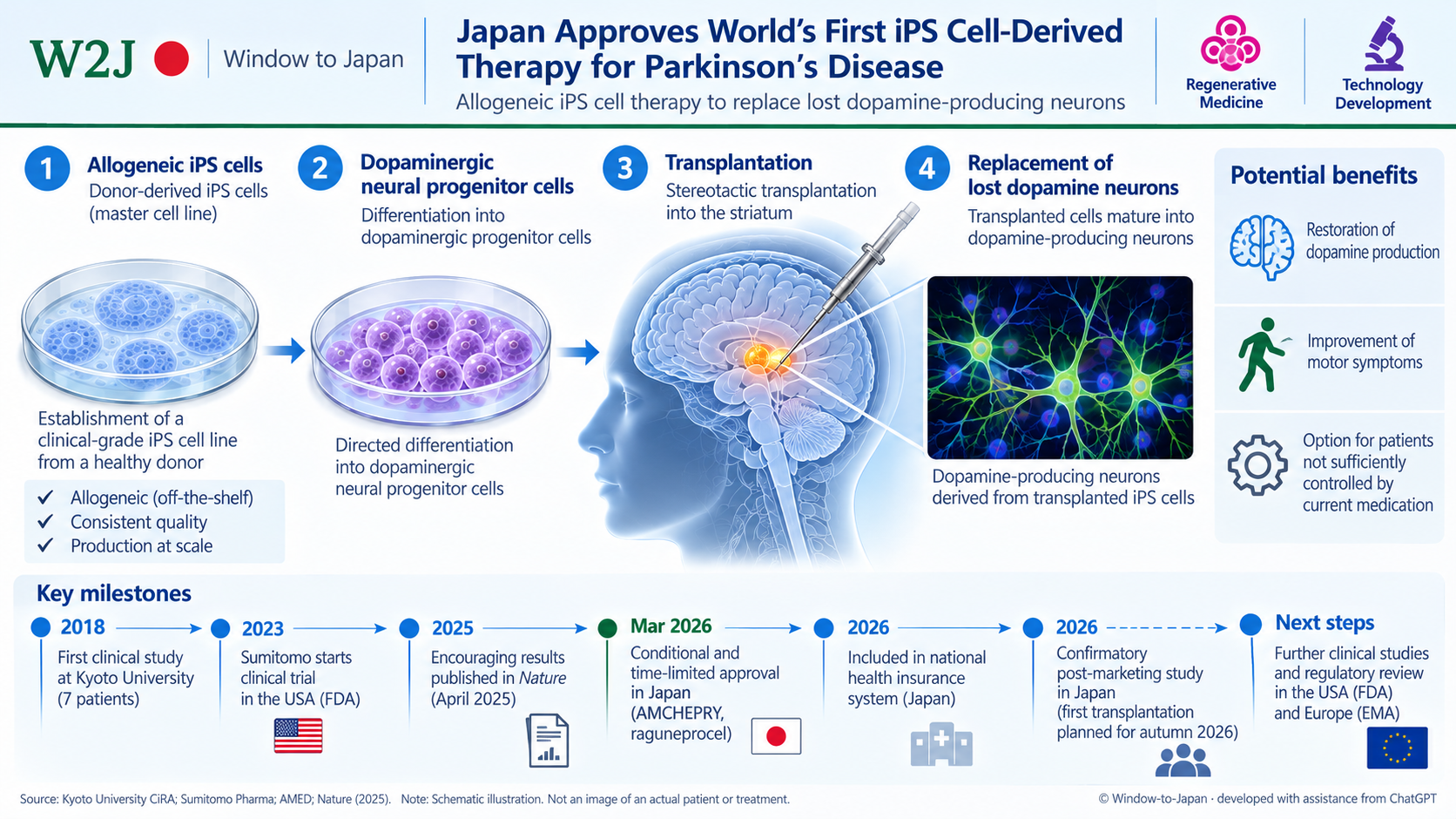
In March 2026, Japan granted conditional and time-limited approval to AMCHEPRY (raguneprocel), the world’s first approved regenerative medicine product derived from induced pluripotent stem (iPS) cells. Developed by Sumitomo Pharma and RACTHERA, the therapy uses allogeneic iPS cells from healthy donors to generate dopaminergic neural progenitor cells for patients with Parkinson’s disease. Clinical development is also progressing in the United States, marking an important step towards the international application of Japanese stem cell technology.
Source: Sumitomo Pharma – Approval of AMCHEPRY, March 6, 2026
Replacing Lost Dopamine-Producing Neurons
Parkinson’s disease is characterized by the progressive degeneration of dopamine-producing neurons in the brain. Conventional treatments, including levodopa, can alleviate motor symptoms but do not replace the lost neurons.
AMCHEPRY follows a regenerative approach. Human iPS cells obtained from healthy donors are differentiated into dopaminergic neural progenitor cells under controlled manufacturing conditions. These cells are subsequently transplanted into the patient’s striatum, where they are expected to mature into functional dopamine-producing neurons.
The allogeneic approach is particularly important. Unlike autologous therapies, which require patient-specific cell production, donor-derived iPS cells can serve as a standardized starting material for manufacturing therapeutic cell preparations for multiple patients.
This offers potential advantages in quality control, manufacturing efficiency and scalability. However, immune compatibility and the possible need for immunosuppression must also be considered.
Source: Sumitomo Pharma – Product and manufacturing technology
Encouraging Clinical Results from Kyoto University
The therapy builds on pioneering research at Kyoto University’s Center for iPS Cell Research and Application (CiRA), led by Professor Jun Takahashi and colleagues.
An investigator-initiated clinical study began at Kyoto University Hospital in 2018. Seven patients with Parkinson’s disease received transplants of allogeneic iPS cell-derived dopaminergic progenitors.
Results published in Nature in April 2025 demonstrated an encouraging safety profile over two years, with no evidence of abnormal cell proliferation. Among six patients evaluated for efficacy, four showed improvements in motor function under OFF-medication conditions. Brain imaging provided evidence consistent with dopamine production by the transplanted cells.
These findings are promising, although the small, uncontrolled study does not yet establish definitive clinical efficacy.
Original publication: Nature (2025), Phase I/II trial of iPS-cell-derived dopaminergic cells for Parkinson’s disease
Japan Grants Conditional Approval
On March 6, 2026, Japan’s Ministry of Health, Labour and Welfare granted conditional and time-limited marketing approval to AMCHEPRY (raguneprocel).
The approved indication covers improvement of motor symptoms in patients with Parkinson’s disease who respond inadequately to existing pharmacological treatments, including levodopa-containing medicines.
Sumitomo Pharma is responsible for commercialization, while S-RACMO handles manufacturing. The product will be manufactured at S-RACMO’s SMaRT facility in Suita, Osaka, a commercial-scale manufacturing facility dedicated to regenerative medicine products derived from allogeneic iPS cells.
Following the approval, a post-marketing clinical study and surveillance programme are intended to provide additional evidence on efficacy and long-term safety required for full approval.
Source: Sumitomo Pharma – Marketing authorization in Japan
Clinical Development Extends to the United States
The international development of this technology began before its Japanese approval.
As reported by Window-to-Japan in December 2023, Sumitomo Pharma, Kyoto University CiRA and the CiRA Foundation supported the initiation of an investigator-initiated Phase I/II clinical trial at the University of California San Diego.
The US Food and Drug Administration (FDA) cleared the Investigational New Drug (IND) application in 2023, allowing the clinical trial to proceed.
As in the Japanese study, the American programme uses allogeneic iPS cells from a healthy donor, provided through the CiRA Foundation’s iPS Cell Stock Project. Dopaminergic neural progenitor cells are manufactured in Japan by Sumitomo Pharma.
Source: Sumitomo Pharma – Start of US investigator-initiated clinical study, December 2023
In March 2024, Sumitomo Pharma also announced FDA clearance of an IND application for a separate company-sponsored Phase I/II study using cryopreserved allogeneic iPS cell-derived dopaminergic progenitors (DSP-1083).
Source: Sumitomo Pharma – Company-sponsored US clinical study, March 2024
According to the company’s current development pipeline, both the investigator-initiated and company-sponsored US programmes remain in Phase I/II development.
Neither programme has yet received FDA marketing authorization. No European marketing authorization from the European Medicines Agency (EMA) has been established.
Source: Sumitomo Pharma – Current development pipeline
From Japanese Research to Regenerative Medicine
AMCHEPRY represents a milestone in Japan’s long-term commitment to regenerative medicine.
Twenty years after Shinya Yamanaka’s pioneering discovery of induced pluripotent stem cells, research originating at Kyoto University has progressed to an approved therapeutic product.
The development illustrates the contribution of academic research, public research funding and industrial collaboration involving Sumitomo Pharma, RACTHERA and manufacturing partners.
Although further clinical confirmation is essential, the Japanese approval and ongoing US studies demonstrate the transition of allogeneic iPS cell technology from laboratory research towards practical medical applications.
The international clinical development of AMCHEPRY also illustrates Japan’s growing role in regenerative medicine and its potential contribution to future treatment options worldwide.
Following the approval, a post-marketing clinical study and surveillance programme are intended to provide additional evidence on efficacy and long-term safety required for full approval.
Source: Sumitomo Pharma – Marketing authorization in Japan
Clinical Development Extends to the United States
The international development of this technology began before its Japanese approval.
As reported by Window-to-Japan in December 2023, Sumitomo Pharma, Kyoto University CiRA and the CiRA Foundation supported the initiation of an investigator-initiated Phase I/II clinical trial at the University of California San Diego.
The US Food and Drug Administration (FDA) cleared the Investigational New Drug (IND) application in 2023, allowing the clinical trial to proceed.
As in the Japanese study, the American programme uses allogeneic iPS cells from a healthy donor, provided through the CiRA Foundation’s iPS Cell Stock Project. Dopaminergic neural progenitor cells are manufactured in Japan by Sumitomo Pharma.
Source: Sumitomo Pharma – Start of US investigator-initiated clinical study, December 2023
In March 2024, Sumitomo Pharma also announced FDA clearance of an IND application for a separate company-sponsored Phase I/II study using cryopreserved allogeneic iPS cell-derived dopaminergic progenitors (DSP-1083).
Source: Sumitomo Pharma – Company-sponsored US clinical study, March 2024
According to the company’s current development pipeline, both the investigator-initiated and company-sponsored US programmes remain in Phase I/II development.
Neither programme has yet received FDA marketing authorization. No European marketing authorization from the European Medicines Agency (EMA) has been established.
Source: Sumitomo Pharma – Current development pipeline
From Japanese Research to Regenerative Medicine
AMCHEPRY represents a milestone in Japan’s long-term commitment to regenerative medicine.
Twenty years after Shinya Yamanaka’s pioneering discovery of induced pluripotent stem cells, research originating at Kyoto University has progressed to an approved therapeutic product.
The development illustrates the contribution of academic research, public research funding and industrial collaboration involving Sumitomo Pharma, RACTHERA and manufacturing partners.
Although further clinical confirmation is essential, the Japanese approval and ongoing US studies demonstrate the transition of allogeneic iPS cell technology from laboratory research towards practical medical applications.
The international clinical development of AMCHEPRY also illustrates Japan’s growing role in regenerative medicine and its potential contribution to future treatment options worldwide.