
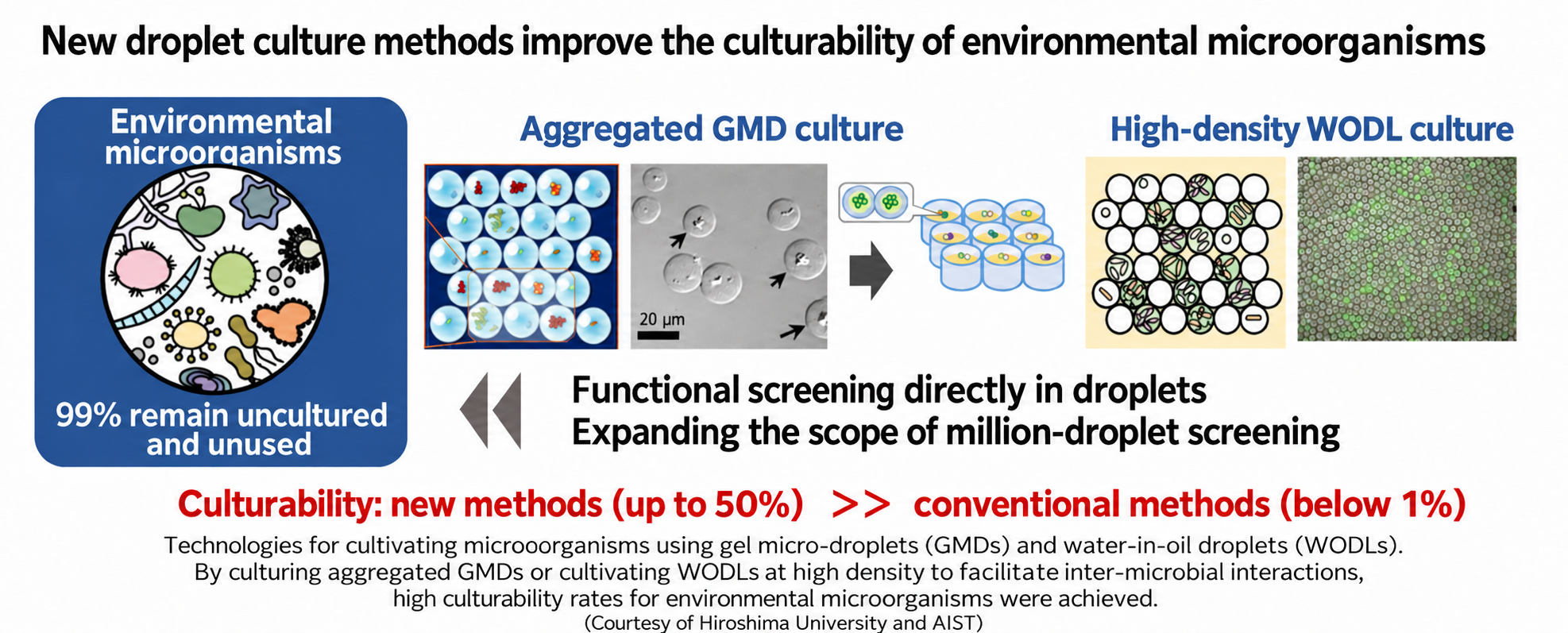
A Japanese consortium has developed a system that combines rapid, assay-based screening of microbial cultures in tiny droplets with image-assisted selection and automated recovery. The aim is to accelerate the discovery of microorganisms and enzymes for biomanufacturing.
Announced by NEDO on 6 October 2026, the project brings together Nagaoka University of Technology, AIST, Hiroshima University, On-chip Biotechnologies and Nikon Solutions. Microorganisms are cultured in water-in-oil droplets, which act as miniature reaction vessels. A screening assay tailored to the desired function identifies promising droplets—for example, through fluorescence generated by enzymatic substrate breakdown.
A published demonstration illustrates the approach: researchers screened approximately one million droplets containing soil microorganisms in six hours, selecting those with the strongest fluorescence from casein degradation. Subsequent cultivation and testing yielded four bacterial species with high proteolytic activity. An enzyme isolated from Lysobacter soli showed 2.4 times the activity of a related commercial enzyme under the tested conditions.
The newly developed system adds an imaging unit that uses image analysis and machine learning to assess features such as microbial growth and morphology. Selected droplets are automatically collected in multiwell plates for further cultivation and testing. Sample preparation, culture conditions and assay design influence which microorganisms are detected; the performance of the image-assisted selection across different microbial types has not yet been publicly established.
The earlier protease study demonstrates functional droplet screening, while validation of the integrated imaging and recovery workflow with environmental samples is ongoing. Test operation is planned for fiscal year 2027, with commercialisation targeted for the end of that fiscal year.
Sources: NEDO, 6 October 2026; Nakamura et al., Applied and Environmental Microbiology, 2025.