AMATERUS AI combines artificial intelligence and quantum chemistry to identify promising synthesis routes for specialty chemicals
Summary
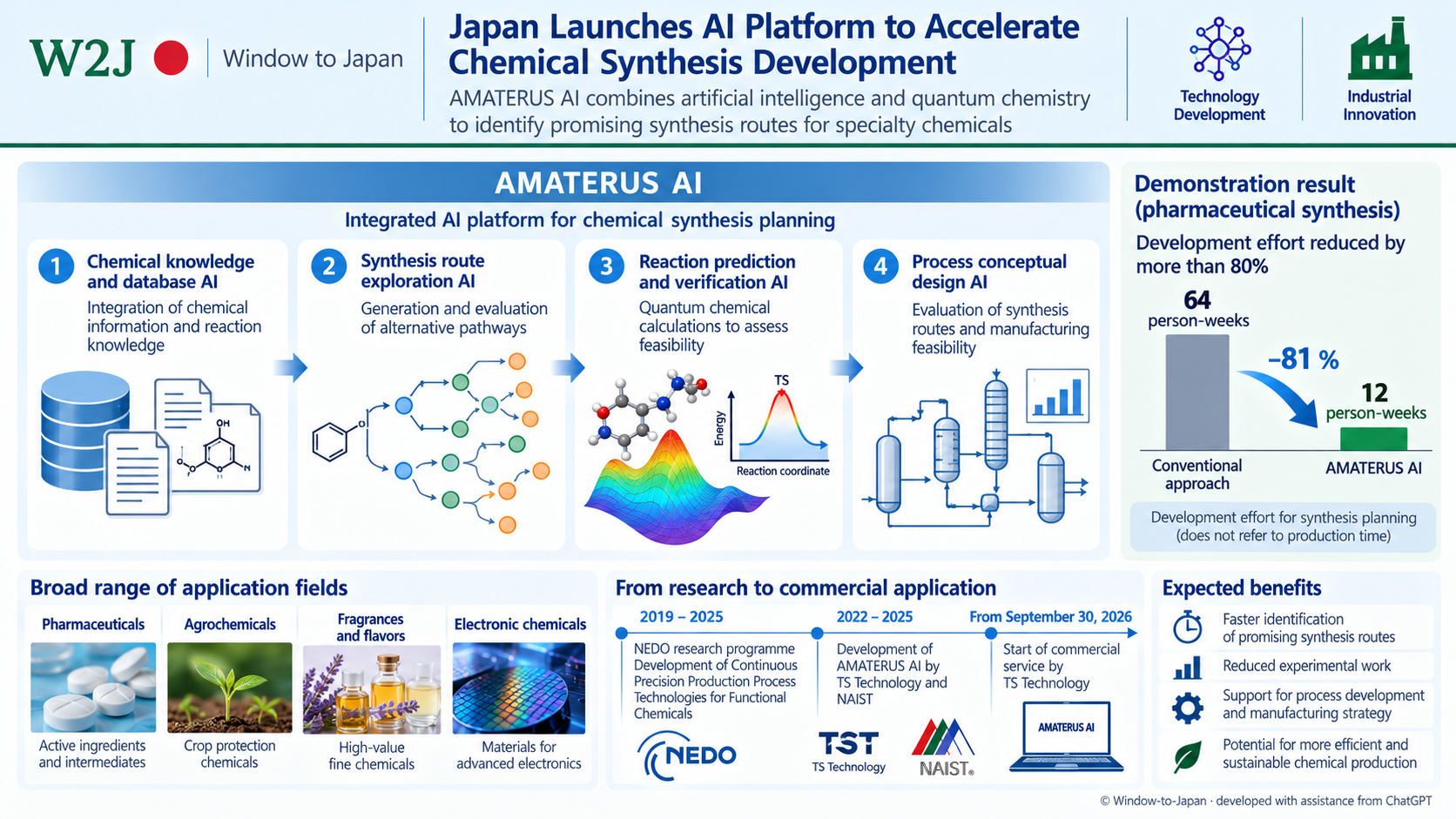
Japan’s New Energy and Industrial Technology Development Organization (NEDO) has announced the development of AMATERUS AI, a software platform that integrates artificial intelligence with quantum chemical calculations to accelerate chemical synthesis planning. Developed by TS Technology and the Nara Institute of Science and Technology (NAIST), the system reduced the development effort for a pharmaceutical synthesis from 64 to 12 person-weeks in a demonstration project. TS Technology launched a commercial service based on the platform on September 30, 2026.
Source: NEDO – Original press release, September 30, 2026
The Challenge: Finding the Best Chemical Synthesis Route
The development of specialty chemicals frequently requires extensive investigation of alternative synthesis routes. Researchers must identify suitable starting materials, select reactions and catalysts, evaluate reaction conditions and consider the feasibility of subsequent manufacturing.
This is particularly demanding for high-value chemicals produced in relatively small quantities, including pharmaceuticals, agrochemicals, fragrances and electronic materials.
Traditionally, synthesis planning relies heavily on literature searches, experimental experience, individual computational tools and repeated laboratory investigations. Exploring the enormous number of theoretically possible reaction sequences can consume considerable time and resources.
AMATERUS AI aims to integrate these activities into a coordinated computational workflow.
Four Integrated Computational Functions
The platform combines four complementary approaches:
- Chemical knowledge and database AI: Organizes chemical information and existing reaction knowledge into a computationally accessible knowledge base.
- Synthesis route exploration AI: Generates and evaluates alternative pathways from available starting materials to the desired target compound.
- Reaction prediction and verification AI: Uses computational methods, including quantum chemical calculations, to assess proposed reactions and their feasibility.
- Process conceptual design AI: Supports the evaluation of synthesis routes from the perspective of subsequent process development.
By integrating these functions, the system can screen and prioritize large numbers of potential synthesis pathways according to the objectives of a particular development project.
The important innovation is not simply the use of AI for retrosynthetic analysis. It is the combination of route generation, reaction evaluation and early process considerations within a single computational platform.
Source: NEDO – AMATERUS AI technology and Figure 1
Development Effort Reduced by More Than 80%
The developers evaluated AMATERUS AI in a pharmaceutical synthesis project.
According to NEDO, the computational approach reduced the work required for synthesis development from 64 person-weeks to 12 person-weeks, corresponding to an approximately 81% reduction.
The project also demonstrated the manufacture of a pharmaceutical product using a synthesis route proposed by the system.
This is an encouraging result, although it represents a specific demonstration rather than a generally established performance level for all chemical syntheses.
Importantly, the reported reduction concerns the effort required to develop a synthesis route. It should not be interpreted as an equivalent increase in the throughput of an operating chemical production plant.
Source: NEDO – Demonstration results and explanatory note 3
From Government-Funded Research to Commercial Application
AMATERUS AI emerged from NEDO’s programme Development of Continuous Precision Production Process Technologies for Functional Chemicals, conducted between fiscal years 2019 and 2025.
The broader programme addressed three technological areas: catalytic and reaction technologies, separation and purification processes, and the application of computational chemistry.
Within this framework, TS Technology, a venture company originating from Yamaguchi University, collaborated with NAIST between 2022 and 2025 to develop the integrated synthesis-planning platform.
On September 30, 2026, TS Technology began offering commercial services based on AMATERUS AI.
The company expects applications in pharmaceutical intermediates and active ingredients, agrochemicals, fragrances and electronic chemicals, where rapid identification of suitable synthesis routes can be particularly valuable.
The service launch represents a transition from publicly funded technology development to industrial application, although broader commercial performance remains to be demonstrated.
Source: NEDO – Project background and commercialization announcement
Towards More Efficient Chemical Manufacturing
The significance of AMATERUS AI extends beyond faster computational synthesis planning.
By identifying promising routes earlier in the development process, the platform may help reduce unnecessary experimental work, accelerate process development and improve the selection of manufacturing strategies.
NEDO also expects its broader programme on continuous precision production to contribute to improved process efficiency and energy conservation.
However, the available announcement does not provide quantified reductions in energy consumption, material use or production costs attributable specifically to AMATERUS AI.
The demonstrated achievement is a substantial reduction in synthesis-development effort, combined with the launch of a commercial service.
The project illustrates Japan’s efforts to integrate artificial intelligence, computational chemistry and industrial process development, particularly for the production of high-value specialty chemicals.