
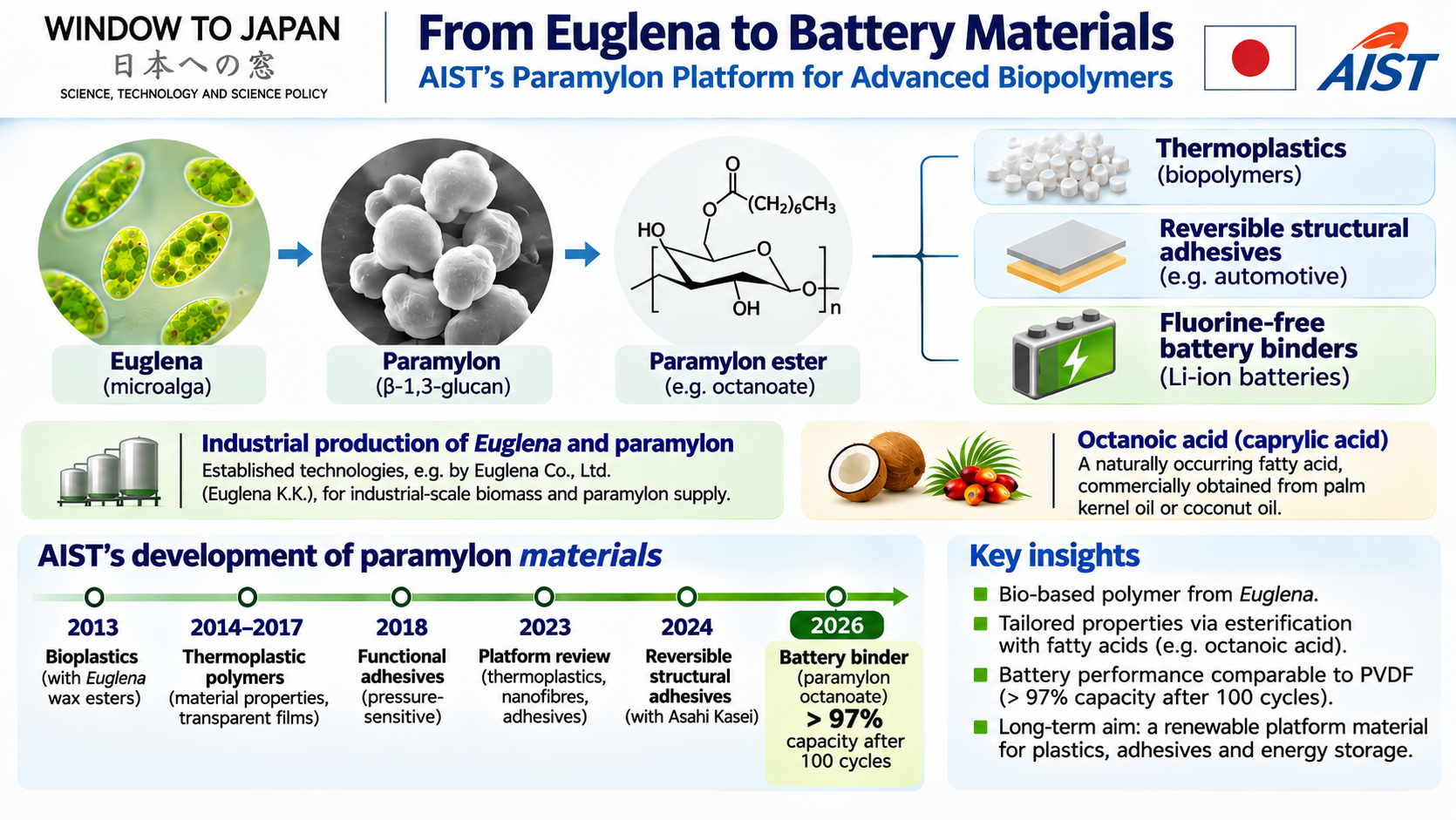
In brief: Researchers at Japan’s National Institute of Advanced Industrial Science and Technology (AIST) have developed a fluorine-free cathode binder for lithium-ion batteries from paramylon, a storage polysaccharide produced by Euglena. The development represents the latest milestone in more than a decade of research into paramylon as a versatile renewable feedstock for the chemical industry.
Paramylon as a renewable platform material
Since the early 2010s, the AIST research group around Motonari Shibakami has investigated the chemical modification of paramylon, a natural β-1,3-glucan. In contrast to cellulose, paramylon is accumulated as intracellular granules in Euglena and can be isolated without complex purification procedures.
Esterification with fatty acids allows its solubility, thermoplastic properties and adhesion to be tailored to specific industrial applications. AIST envisages paramylon as a renewable platform feedstock with a role analogous to that of naphtha in the petrochemical industry.
More than a decade of materials development
- 2013 – Bioplastics: AIST demonstrated thermoplastic materials based on paramylon modified with fatty acids derived from Euglena wax esters or with derivatives of cardanol obtained from cashew nut shells. AIST, 2013.
- 2014–2017 – Thermoplastic polymers: Systematic studies established relationships between the chemical structure, thermal properties and mechanical performance of paramylon mixed esters. Transparent films with mechanical properties comparable to those of analogous cellulose derivatives were obtained. Shibakami et al., 2014; Shibakami and Sohma, 2017.
- 2018 – Functional adhesives: Research on paramylon monoesters extended the material platform towards pressure-sensitive adhesives. Shibakami and Sohma, 2018.
- 2023 – A diversified materials platform: A review summarised developments in thermoplastic resins, nanofibres and adhesives based on paramylon. Shibakami, 2023.
- 2024 – Automotive structural adhesives: In collaboration with Asahi Kasei, AIST demonstrated thermally reversible bonding of aluminium components. The adhesive retained its bonding performance over repeated bonding and disassembly cycles, opening perspectives for automotive recycling. AIST and Asahi Kasei, December 2024.
- 2026 – Battery materials: The platform has now been extended to fluorine-free cathode binders for lithium-ion batteries.
Replacing fluorinated battery binders
In its latest development, announced on November 16, 2026, AIST identified paramylon octanoate as a potential alternative to polyvinylidene fluoride (PVDF), a widely used cathode binder in lithium-ion batteries.
Experimental pouch cells combining lithium cobalt oxide cathodes and graphite anodes retained more than 97% of their discharge capacity after 100 cycles, matching the performance of conventional PVDF-based cells.
The new binder is compatible with conventional solvent-based electrode manufacturing, although the process still uses N-methyl-2-pyrrolidone (NMP). AIST, November 16, 2026.
Towards a fully bio-based functional polymer
Octanoic acid (caprylic acid) is a naturally occurring medium-chain fatty acid that can be obtained from coconut or palm kernel oil. Combining biotechnologically produced paramylon with an oleochemically derived fatty acid could therefore provide a fully bio-based alternative to a petrochemical fluoropolymer.
Japan’s Euglena Co., Ltd. is an obvious potential industrial partner for the supply of paramylon. However, neither its participation in the current battery project nor the biological origin of the octanoic acid has yet been confirmed.
Industrial scalability, long-term battery performance, production costs and environmental benefits remain to be established.
The long-term perspective: The research programme illustrates how a biologically produced polysaccharide can become the basis of a diversified materials platform, extending from thermoplastics and recyclable structural adhesives to advanced electrochemical applications.
Further reading
- AIST (2013). Development of Euglena-based Bioplastics.
- Shibakami, M., Tsubouchi, G. and Hayashi, M. (2014). Thermoplasticization of euglenoid β-1,3-glucans by mixed esterification. Carbohydrate Polymers 105, 90–96. DOI.
- Shibakami, M. et al. (2015). One-pot synthesis of thermoplastic mixed paramylon esters using trifluoroacetic anhydride. Carbohydrate Polymers 119, 1–7. DOI.
- Shibakami, M. and Sohma, M. (2017). Synthesis and thermal properties of paramylon mixed esters and optical, mechanical, and crystal properties of their hot-pressed films. Carbohydrate Polymers 155, 416–424. DOI.
- Shibakami, M. and Sohma, M. (2018). Thermal, crystalline, and pressure-sensitive adhesive properties of paramylon monoesters derived from an euglenoid polysaccharide. Carbohydrate Polymers 200, 239–247. DOI.
- Shibakami, M. (2023). Production of Organic Materials Made from Euglenoid Polysaccharide. Oleoscience 23, 87–93. DOI – open access.
- AIST and Asahi Kasei (2024). Creation of a Novel Bio-based Adhesive Using Euglena-derived Materials to Bond Automotive Structural Components.
- AIST (2026). Fluorine-free battery binder based on paramylon (Japanese, November 16, 2026).