
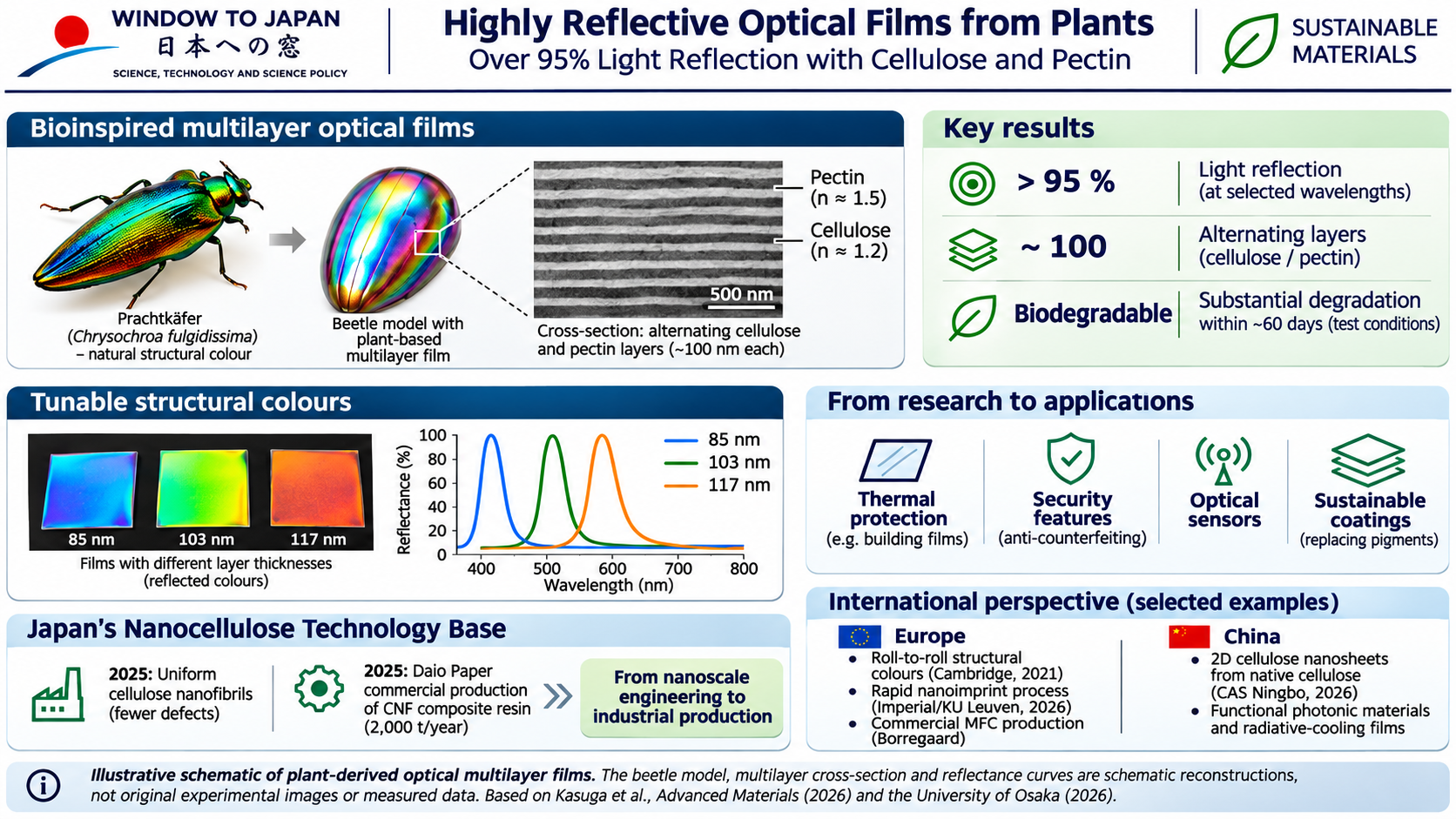
In brief: Researchers at the University of Osaka have developed highly reflective optical films from cellulose nanofibers and pectin. Their multilayer structures reflect more than 95% of light at selected wavelengths without conventional pigments or petroleum-derived polymers. Potential applications include structural colours, optical sensors and passive thermal protection. The achievement adds a new dimension to Japan’s growing nanocellulose technology base. University of Osaka, 2026.
High Reflectivity from Plant-Derived Polymers
A team led by Takaaki Kasuga and Masaya Nogi at the University of Osaka developed optical films consisting of alternating layers of porous cellulose nanofibers and dense pectin. Using electrodeposition, the researchers fabricated approximately 100 layers with individual thicknesses around 100 nanometres.
The key innovation is the contrast in refractive index between the porous cellulose layers (approximately 1.2) and the dense pectin layers (approximately 1.5). This produces strong optical interference and exceptionally high reflection at selected wavelengths.
The researchers demonstrated tunable structural colours, patterned films and multilayer configurations with broader reflection bands. The materials also showed substantial biodegradation under specified experimental conditions. Kasuga et al., Advanced Materials, 2026; University of Osaka, 2026.
Applications and Remaining Challenges
Potential applications include sustainable decorative coatings, optical security features, sensors and thermal-control materials.
Films designed to reflect near-infrared light while transmitting visible light could help reduce solar heat gain in buildings. The Osaka team demonstrated this potential using a laboratory thermal-shielding experiment.
However, reflectivity exceeding 95% at selected wavelengths must not be confused with equivalent reflection across the entire solar spectrum. Moisture resistance, long-term durability and scalable manufacturing remain important challenges. University of Osaka, 2026.
Japan’s Industrial Nanocellulose Technology Base
The Osaka development is part of Japan’s broader progress in cellulose nanofiber research, processing and industrial applications.
In 2025, Japanese researchers reported the preparation of particularly uniform cellulose nanofibrils with reduced structural defects, demonstrating further advances in nanoscale cellulose engineering. Window-to-Japan, 2 May 2025.
Industrial implementation is also progressing. Daio Paper Corporation began commercial production of its ELLEX-R67 cellulose nanofiber composite resin in 2025. The facility has an annual production capacity of 2,000 tonnes of composite material. The pellets contain 67% cellulose-based reinforcement, with polypropylene and a compatibilising resin making up the remainder. Applications include automotive components and household appliances. NEDO, 2025; Window-to-Japan, 29 July 2025.
These developments illustrate Japan’s capabilities from nanoscale material engineering to commercial materials production. However, producing CNF-reinforced thermoplastic composites is technologically different from manufacturing precision optical multilayers. Commercial production of the Osaka films has not yet been demonstrated.
International Perspective
Cellulose-based functional materials are an active field of international research and industrial development.
Europe: Researchers at the University of Cambridge demonstrated continuous roll-to-roll fabrication of structurally coloured cellulose nanocrystal films, addressing an important manufacturing challenge. Nature Materials, 2021.
More recently, researchers at Imperial College London and KU Leuven reported a rapid wet nanoimprint process for producing tunable structural colours in nanocellulose films. The process substantially reduces the time required for optical structuring. ACS Nano, 2026.
Europe also has established industrial capabilities: Norway’s Borregaard produces microfibrillated cellulose commercially.
China: Researchers at the CAS Ningbo Institute of Materials Technology and Engineering developed a method for obtaining two-dimensional cellulose nanosheets from native cellulose, expanding the range of cellulose nanostructures available for functional materials. CAS, 2026; Window-to-China, 2 May 2026.
These approaches are complementary rather than directly equivalent. The distinctive contribution from Osaka is the combination of very high wavelength-selective reflectivity, plant-derived polymers and precisely controlled multilayer architectures.
Outlook
The Osaka study demonstrates how nanoscale structural engineering can transform abundant natural polymers into high-performance optical materials.
Its commercial prospects will depend on improvements in moisture resistance, durability, production efficiency and cost competitiveness.
Together with advances in nanocellulose manufacturing in Japan and internationally, this work illustrates the growing potential of cellulose as a renewable platform for advanced functional materials.